
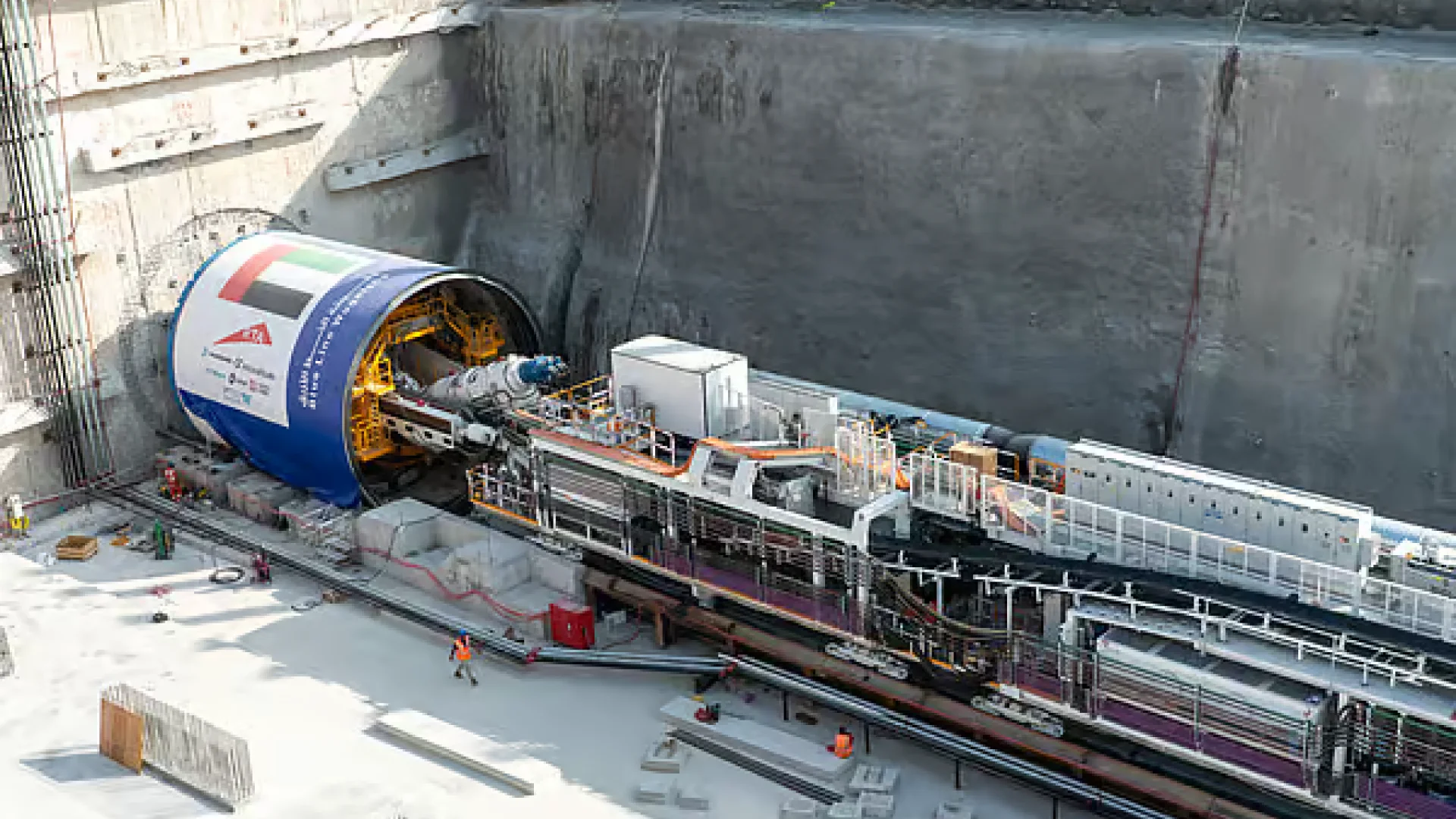

Beneath Dubai’s heat and highways, the Blue Line is already taking shape: construction has started, with underground tunnelling and early works progressing along the future route. The expansion is designed to strengthen connections across growing districts, improve interchange logic, and ease pressure on roads as the city adds more homes, jobs and visitors. What looks like a construction site today is, in practice, a new timetable for everyday life—shorter trips, clearer access, and neighbourhoods that suddenly feel closer. For residents, businesses and investors, it’s a signal that the next wave of demand will follow the stations.
Down here, the city sounds different.
Not the sharp honk of Sheikh Zayed Road. Not the airy hush of a mall. This is a low, steady roar—like a giant breathing through steel. Light floods the tunnel face in hard white, catching dust that floats for a second before settling on boots and gloves. A worker leans in, taps a concrete ring, and calls out to a colleague, half-grinning: “Perfect fit.”
This is the Dubai you rarely see: the one beneath the Dubai you know.
While towers keep rising above ground, Dubai’s Metro Blue Line is beginning its life below it. Construction is underway, with underground tunnelling progressing as part of the early works and site activity along the future alignment. The drama isn’t in speeches. It’s in millimetres. In monitoring screens. In the quiet confidence of people who know that a tunnel, once sealed and operational, must feel effortless forever.
Every city has a pulse. In Dubai, it’s fast—sometimes dizzyingly so. And transport is the metronome that decides whether that pace feels exhilarating or exhausting. The Blue Line is being built to add capacity and, just as importantly, structure: better links between growing areas, stronger interchange points, and a network that can carry more people with less friction.
Ask anyone who commutes regularly and they’ll describe the same small battles: the extra exit you didn’t anticipate, the parking hunt that steals ten minutes and your patience, the creeping realisation that “near” on a map can still be far in real life. Metro expansions change that calculation. They redraw the city into walkable fragments connected by predictable time.
And predictability, in a city that keeps reinventing itself, is a luxury.
A site supervisor stands near a shaft opening, scanning a dashboard of numbers as if he’s watching a heart monitor. Pressure. Alignment. Tolerances. He looks up only briefly, long enough to nod at a team member headed down. “Keep it steady,” he says. Not loudly. He doesn’t need to. The machines are already doing the shouting.
Underground tunnelling is part engineering and part choreography. Segment by segment, the tunnel lining forms a repeating pattern—massive rings that lock into place with a finality that feels almost satisfying. There’s a moment, after each piece is set, when the team pauses. A quick glance. A small nod. Then the sequence starts again.
Above, the city keeps moving. Below, the city is being prepared to move differently.
When a project like the Blue Line shifts from announcement to active works, the change is tangible. Detours appear. Barriers line up like punctuation marks along the roadside. Construction vehicles idle in the heat, waiting for their turn. To most passers-by, it’s inconvenience.
To Dubai, it’s commitment.
Because the moment tunnelling begins, the project stops being a concept and becomes a physical fact. The ground has been opened. The route is no longer just an idea on a map—it’s a corridor taking shape under your feet.
In a café near one of the active zones, two office workers peer out at the works through the glass. “That’s the Blue Line, right?” one asks, stirring coffee without looking down.
“Yeah,” the other replies. “When it’s done, I’m not driving.”
It’s a casual exchange, the kind that lasts five seconds and disappears into the day. But it carries the weight of what transit changes do: they alter habits. They reshape routines. They make new forms of convenience normal.
Dubai has always been a city of movement—of arrivals, departures, reinvention. The Metro system has been one of the few elements that gives that motion a dependable spine. The Blue Line is set to thicken that spine, giving growing districts more direct access and strengthening the logic of interchange across the wider network.
A metro map can look simple: coloured lines, neat stations, clean angles. Real life is messier. People don’t travel in straight lines; they travel between obligations. Home to school. Gym to meeting. Grocery run to dinner. The “value” of a new line often concentrates around the points where choices multiply—interchanges and well-connected stations that turn a single route into dozens of possibilities.
That is where time gets saved in meaningful chunks. Not two minutes here and there, but the kind of consistent reduction that makes someone choose transit over a car, day after day. In Dubai, where road networks are vast and car culture is deeply embedded, that shift is significant. It reduces congestion pressure, improves daily predictability and supports denser, more walkable development patterns around stations.
Dubai is often photographed as a skyline. But the skyline is only one layer. There’s the layer of roads and bridges, constantly being widened, rerouted, upgraded. And now, again, there’s the layer beneath—quiet, engineered, precise.
In the tunnel, the air is cooler. The light is harsher. The work is repetitive in the way that only important work can be. You watch a segment swing into place and you realise how much of the future depends on invisible things being done correctly, repeatedly, without drama.
Someone wipes sweat from their forehead, leaves a faint grey streak of dust behind, and laughs at a joke you don’t quite catch. Then the roar deepens. The machine pushes forward. And the city, above it all, keeps shimmering in the sun—unaware, in the way people are always unaware of the foundations that carry them.
In Dubai, new Metro capacity is more than a mobility upgrade—it’s a pricing signal. Station proximity tends to change how residents, tenants and employers evaluate convenience, and convenience is one of the few fundamentals that remains valuable across market cycles. As the Blue Line moves from planning into visible construction—including underground tunnelling—the “future accessibility” of certain districts becomes easier for the market to believe, and that belief can translate into earlier demand and faster absorption for well-positioned projects.
1) The typical value curve: announcement → works → delivery
Investors often see three phases around major transit projects:
The current “works underway” stage is frequently where opportunities exist—provided buyers avoid paying purely for hype and focus on assets that will benefit from real, walkable access.
2) What tends to benefit most
3) Micro-location due diligence: “near” is not enough
The difference between a seven-minute shaded walk and a fifteen-minute crossing-heavy walk can be the difference between a rent premium and indifference. Investors should evaluate:
4) Development and liquidity implications
Metro expansion often encourages denser, more “complete” neighbourhood planning—residential plus retail plus community uses—because reliable transit supports higher utilisation. Over time, that can improve transaction liquidity and price discovery in station catchments, attracting a broader buyer pool including international investors who screen markets through a transit-oriented lens.
5) Practical strategy
A disciplined approach is to map a station catchment, shortlist assets with genuine walkability, then underwrite conservative rents during the construction period with upside scenarios post-opening. In Dubai’s fast-moving market, the Blue Line is not just infrastructure—it’s a framework for where demand may concentrate next.